Skiing from Dolomites Escapes
Your base
under Mount Antelao
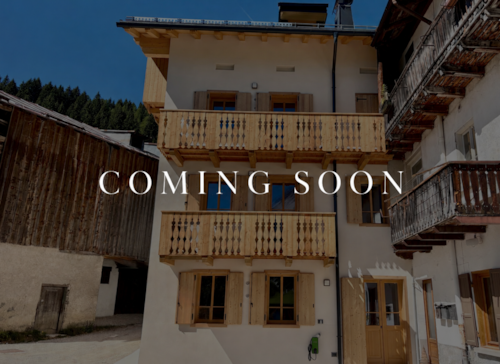
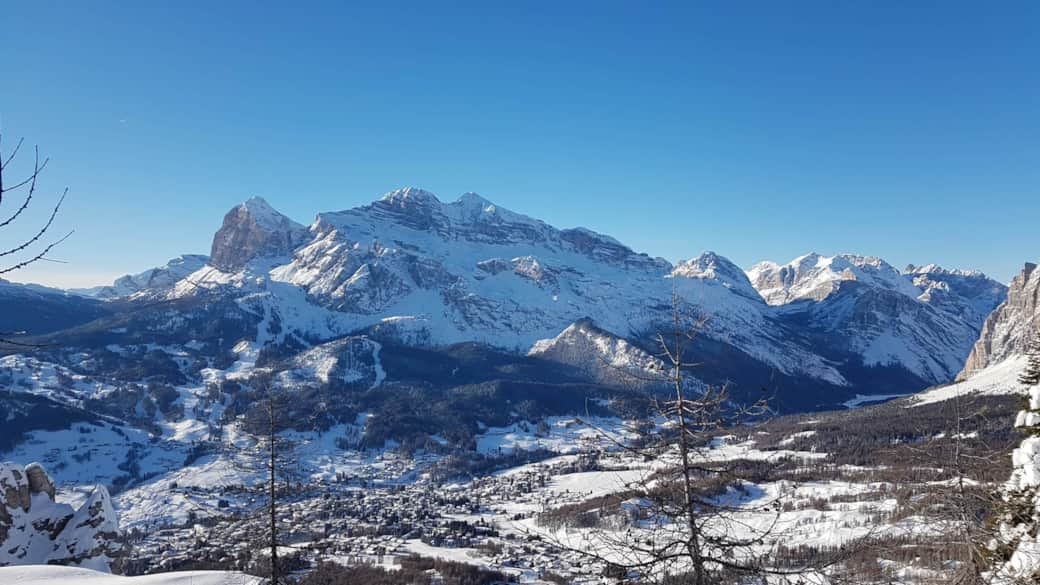
The house sits in San Vito di Cadore, in the Val Boite at the foot of Monte Antelao — the “King of the Dolomites.” Ski slopes are 2.4 km from the house, Cortina is 12 km away, and the whole Dolomiti Superski network — 12 resorts on a single pass — is just beyond. With a Scuola Sci Cortina instructor for a host, you’ll always be pointed to the right run at the right time. Learn on gentle local slopes in the morning and be on an Olympic downhill course fifteen minutes later.
- San Vito slopes 2.4 km away
- Cortina 12 km, about 15 minutes
- 12 resorts, one pass
Close to home: the San Vito ski area
San Vito’s slopes and lifts are 2.4 km from the house — small, sunny and quiet, and ideal for beginners, families and warming up. The area runs from about 1,040 m to 1,580 m with nine pistes over roughly 15 km — around 40% blue, 53% red and 7% black, with snowmaking on every run.
From the village, the Donarié drag lift serves a good beginner field and feeds the Tambres chair, which opens up the blue Brosolas (perfect for first turns), the red Caprioli and the black Ciastel — short but with genuine pitch. Higher up, the San Marco chair reaches two more direct reds, Bianca and Antelao, used by ski clubs for training, plus the more playful Serpentina.
The NeveSole park, with conveyor lifts, sledging and games, is a supervised space for young children. You’re skiing sun-facing balcony clearings with views of the Antelao, Pelmo and Marmarole. A free skibus links the house side of the village to the lifts.
Cortina d’Ampezzo: 12 km away
Cortina’s ski area alone is 120 km across 86 runs, split into the Tofane, Faloria–Cristallo, 5 Torri–Lagazuoi and San Vito–Auronzo–Misurina sectors. Its centrepiece is the Olympia delle Tofane. It debuted with the men’s downhill at the 1956 Winter Olympics, became the women’s World Cup downhill course, hosted the 2021 World Championships, and staged the women’s alpine events at the Milano-Cortina 2026 Olympics and the Para-alpine events at the 2026 Paralympics. At around 2,560 m long with 750 m of vertical, it’s a serious test — but here’s the useful part for guests: after the 2026 Paralympics, Cortina reopened the Tofane sector to recreational skiers, so the Olympic downhill is now simply a red piste you can ski on a normal lift pass.
The Freccia nel Cielo cable car climbs in three stages from the Cortina valley station at 1,224 m to Col Druscié (1,778 m), Ra Valles (2,470 m) and finally Tofana di Mezzo at 3,244 m. For experts, Forcella Rossa is the steepest piste in Cortina — about 2 km with 700 m of vertical and a maximum around 72% — alongside the ungroomed Vertigine Bianca and the steep Canalone and Labirinti. Beginners get their own beautiful, easy terrain at Socrepes and Pocol.
Cortina’s quieter side
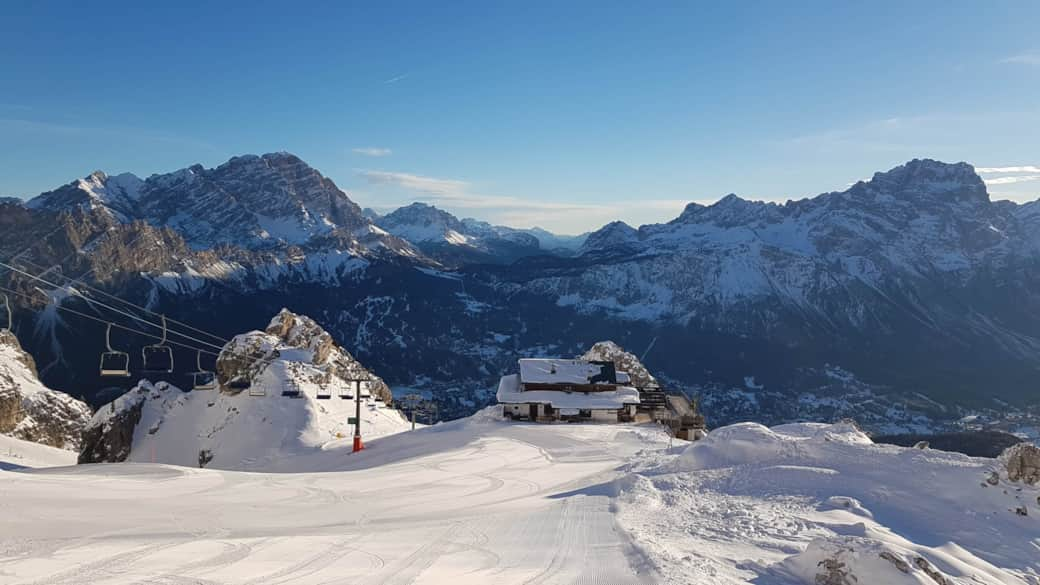
Across the valley from the Tofane, the Faloria–Cristallo sector is red-run heavy, largely tree-lined (which makes it the smart choice in flat light or bad weather), and reliably less crowded. The Faloria cable car climbs straight from the centre of Cortina — a route first opened in 1939 as the “Principe di Piemonte” lift — to Monte Faloria at around 2,120 m. The signature run is the Vitelli, a long red tracking beneath the Cristallo walls, while the Tondi di Faloria pistes sit directly under the cable-car line and catch the morning light. The Vitelli slope hosted the giant slalom at Cortina’s 1956 Winter Olympics.
The Cristallo side is reached from Rio Gere (7 km from town, with free parking and a ski bus), where a four-seat chairlift climbs to Son Forca beneath the 3,221 m Cima Cristallo, with the sunny, well-loved Rifugio Son Forca on the run.
An honest heads-up. The lift to Forcella Staunies at the top of Cristallo has been closed since 2016, so the famous Staunies couloir is currently inaccessible — worth knowing, since older guides still list it.
Cruising slopes and open-air history
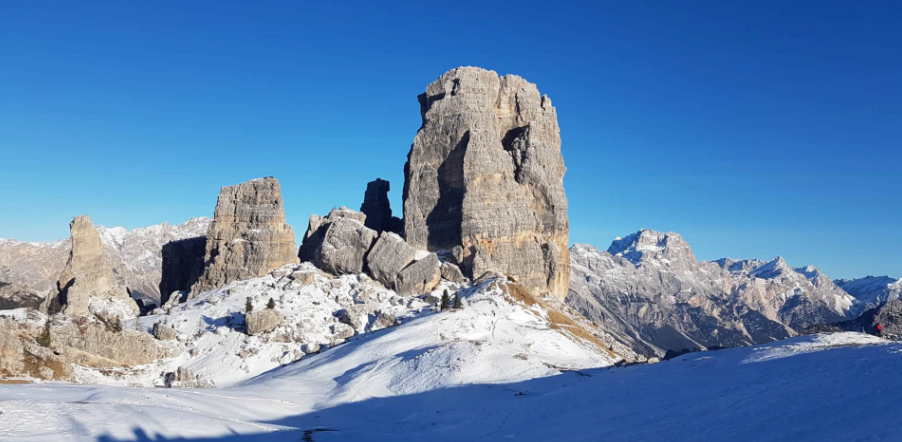
Over the Passo Falzarego, the Cinque Torri area is one of Cortina’s most scenic and crowd-free places to ski — gentle-to-intermediate cruising beneath the unmistakable Cinque Torri rock towers, with views across to Croda da Lago and the Tofana di Rozes. Thanks to the new Cortina Skyline gondola, built for the 2026 Olympics, you can now ski across from the Tofane side to the 5 Torri and Falzarego–Lagazuoi slopes without a bus or taxi. The runs here — the Scoiattoli and Cinque Torri reds off the 5 Torri chairlift — are quiet and flowing, and a nearby beginner area at Col Gallina makes it friendly for mixed-ability groups.
What sets Cinque Torri apart is the history underfoot: it was the scene of fierce First World War fighting, and today has an open-air war museum with reconstructed trenches, plus Rifugio Nuvolau — the oldest refuge in the Dolomites — on the ridge above. It’s also the natural launch point for the Great War Ski Tour, which starts inside the local ski area rather than asking you to transfer elsewhere.
The big day out
Can you ski the Sellaronda from here? Yes, with a short drive.
Two of the world’s great ski tours start within reach of the house. The Sellaronda is the famous four-pass carousel that loops the Sella massif on skis; alongside it runs the Great War “Peace Route,” which crosses the First World War front line over Passo Falzarego via the celebrated Lagazuoi–Armentarola descent. Both need a Dolomiti Superski pass and a full day.
From the Cortina side you reach it over a fifth pass, Falzarego, via one of the most celebrated descents in the Alps. The Lagazuoi cable car lifts you from Passo Falzarego (2,107 m) to 2,732 m in three minutes on an unusual fixed-rope design with no pylons. From the top you drop onto the Armentarola: an 8.5 km run through the Fanes-Sennes-Braies nature park, beneath sheer rock walls and frozen waterfalls. At the flat run-out at Sass Dlacia, a team of horses tows skiers along the level ground to the Armentarola lift. The route is also part of the Great War Ski Tour and the Super8, crossing the First World War front line past tunnels and trenches on the Lagazuoi ridge.
One planning note: skiing down from Lagazuoi into Val Badia and Armentarola leaves you in a different valley, so you’ll need to take the ski bus or a taxi from Armentarola back to Passo Falzarego. It’s a full-day outing.
Catch the first cable car of the morning.
Beyond the pistes
The valley is a ski-touring and freeride heartland — the Lagazuoi–Cinque Torri and classic tours around the Cristallo, Sorapis and Marmolada. Cortina also has some of the best freeride terrain in the Dolomites, including the famous Bus de Tofana. For cross-country skiers, the Dobbiaco–Cortina marathon traces the old railway through Lake Landro into Cortina each winter.
Which ski pass do I need?
Three tiers, so guests can match the pass to the trip.
| Pass | What it covers |
|---|---|
| San Vito only | Bought at the ski-area cash desks; ideal for a family day on the local slopes. |
| Valley pass (Skipass di Valle) | Covers Cortina d’Ampezzo, San Vito and Auronzo–Misurina, giving access to 47 lifts and around 120–140 km of pistes. |
| Dolomiti Superski | The full network: 12 valleys and about 1,200 km of pistes, needed for the Sellaronda and the big tours. |
Skiing FAQs
How far is the skiing from the house?
San Vito’s own lifts are 2.4 km away; Cortina d’Ampezzo is 12 km (about 15 minutes) up the valley; and the wider Dolomiti Superski network of 12 resorts opens up from there.
Is it good for beginners and families?
Yes — San Vito is a sunny, uncrowded, family-focused area with gentle blue runs and a supervised children’s park, and Cortina’s Socrepes and Pocol offer easy terrain with spectacular views.
Can I ski the Sellaronda and the Cortina slopes on the same trip?
Yes, though you’ll want to be quick: there’s a lot of ground to cover. The Sellaronda four-pass circuit and the Cortina slopes are all on the Dolomiti Superski pass; from Cortina you reach the Sellaronda over Passo Falzarego via the Lagazuoi–Armentarola descent.
What is the Armentarola run?
An 8.5 km descent from the Lagazuoi cable car through a dramatic protected valley of rock walls and frozen waterfalls, famous for the horse tow that pulls skiers across the flat section at the bottom.
Can I book ski lessons?
Yes — your host is a Scuola Sci Cortina instructor, and lessons can be arranged through Scuola Sci Cortina.
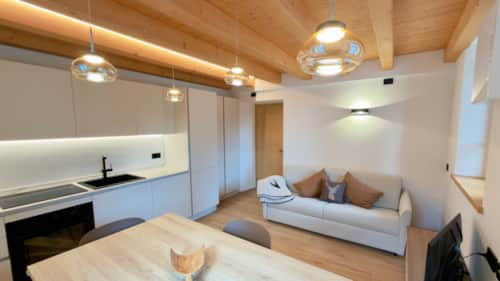
Ground-Floor Apartment · Sleeps 4 · near Cortina
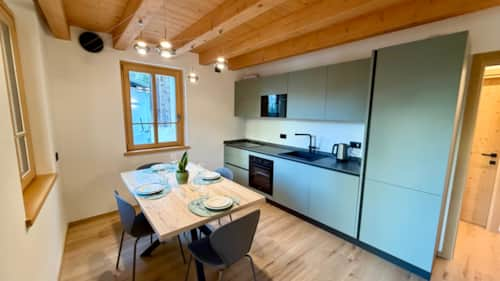
First-Floor Apartment · Sleeps 4 · near Cortina
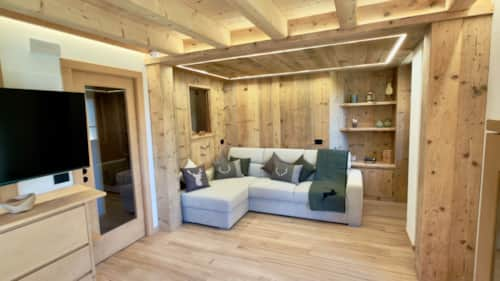
3-Bedroom Alpine Duplex · Sleeps 6 · near Cortina